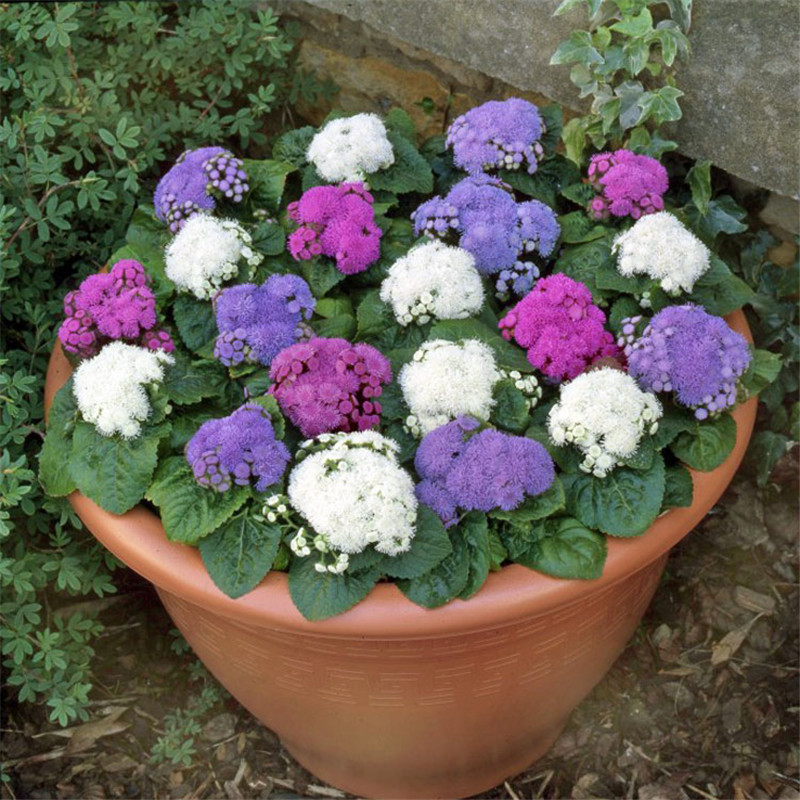
Ageratum is native to Central America and Mexico, it is now cultivated worldwide as a popular ornamental plant for borders, containers, and garden beds.
How to Choose Ageratum Seeds
Ageratum seeds are very small, with a length of about 0.5-1 millimeters and a width of about 0.2-0.3 millimeters. They are slender and flat, with slightly pointed ends and a wider middle. They appear dark brown or black in color, with a slight luster and small longitudinal stripes on the surface. When selecting, choose seeds with full and evenly sized seeds to avoid withered or damaged seeds The new seeds have a bright and glossy color, while the aged seeds have a dull color When selecting, avoid mold, insect infestation, and impurities.
Where to Plant Ageratum Seeds
Ageratum has strong planting adaptability and can survive from low altitude to high altitude areas up to 2800 meters. The best growing areas are warm and humid low altitude areas. Ageratum is sensitive to cold, and for self-protection, it will stop growing in environments below 5 ℃ in winter. Sunlight exposure can make Ageratum grow better, and at least 6 hours of light per day can maximize its ornamental value. A soil with a pH of 6.0-7.5 can enable Ageratum to efficiently absorb nutrients, while loose and fertile sandy soil is better. Good drainage can prevent root rot.
When to Plant Ageratum Seeds
Sow Ageratum seeds indoors 6-8 weeks before the last expected frost for early blooms.For direct sowing outdoors, wait until all danger of frost has passed and the soil has warmed.In frost-free climates, Ageratum seeds can be sown in autumn for winter and spring flowers.

How to Plant Ageratum Seeds
Due to the small size of Ageratum seeds, the task of sowing has become relatively difficult. The sowing time is generally determined according to the flowering period of Ageratum, which can be adjusted to regulate its flowering period. If they need to bloom around Labor Day, they can be sown at the end of August and early September of the previous year, so they need to be kept in a greenhouse for the winter until late April of the following year before they can leave the greenhouse.
How to Care for Ageratum
Ageratum prefers damp environments, but is afraid of water accumulation. When the soil surface in the flowerpot turns white and dry, water thoroughly. During the growth period, water twice a day (once every 3-5 days in winter). Apply diluted fertilizer every 10-15 days. Ageratum has strong branching ability, regularly plucking and topping 3-4 times to promote branching and maintain a compact and beautiful plant shape. Every spring, replanting, soil replacement, and root restoration can be carried out to promote plant regeneration and growth. When discovering pests and diseases, spray pesticides in a timely manner for treatment. Ageratum can be propagated through sowing and cutting. Sow seeds in greenhouses or plant branches in open fields according to climatic conditions. Cutting can be done in all growing seasons except for winter. Choose robust branches, keep 2-4 true leaves, cut and insert as needed, it takes about 10 days to root.
Nothing can add a gentle and lasting color to a garden like Ageratum. Their clusters of flowers, like everlasting blue purple clouds, shine brightly from late spring to late autumn. When butterflies dance gracefully among the flowers, the leisurely and romantic countryside garden scene you dreamed of quietly comes true. Why not plant hope now and wait for this peaceful beauty to bloom in your courtyard.